
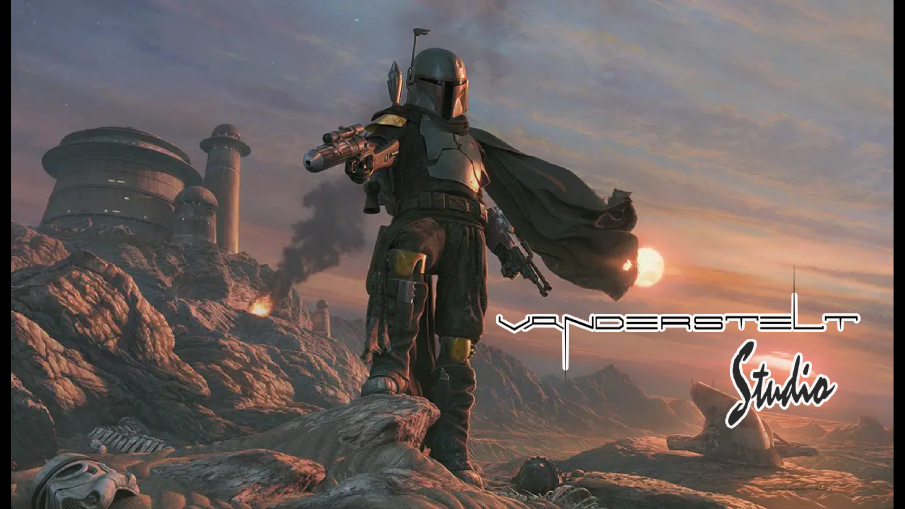
“If you can somehow capture the heart of your audience by taking them by the hand and cause them to participate in the journey and enter your world, even for a short time, then you’ve down your job.” – Jerry Vanderstelt
Few artists in the world of fandom have captured the heart of beloved franchises quite like Jerry Vanderstelt. With amazing detail and style, Vanderstelt’s work brings characters and scenes from Star Wars, The Lord of the Rings, Indiana Jones, and more to life. His ability to balance technical mastery with storytelling has earned him a place among the most respected illustrators in pop culture. From epic battles to moments of heroism, Jerry Vanderstelt’s art reminds us why we love these worlds in the first place. Vanderstelt proves that when passion and talent collide, the results are iconic. We caught up with Jerry to talk about his creative process, his inspirations, and why fandom continues to fuel his passion for painting.
Your work captures so much detail. Can you walk us through your creative process when starting a new piece?
Typically, depending on what Intellectual Property I might be working on, my first steps are to go through all my filing cabinet folders, digital images and general references to see if I can pull any inspiration from them to get a baseline and see what might help my mental picture of what I am aiming for to begin building a concept. The full list of a “how-to” would take quite a long time to explain, but next steps after compiling ideas with a sort of “mood board” is to then rough in a few sketches ( digital or traditional, or both ). Once you have a base for the direction you want, you then finalize your actual references to use for the paint process itself. This reference can be photos from your own photo shoot, images of a complex dimensional geometric shape, or even a 3d rendered object that has answers to lighting, shading or points of view that guide you. All these reference sources serve as guides to getting a concept on the painting surface, or even in a digital format.

Many of your paintings feature popular franchises like Star Wars, Lord of the Rings, and Indiana Jones. What draws you to these specific universes as an artist?
We all have our favorite movies that move us. These Intellectual Properties ( IP ) are worlds in themselves as films. Many artists will create scenes we have all seen before, based on references many will recognize. However, a well done piece of art can be beautiful and heighten our love for these films. However, what draws me to these IPs is the challenge to take a moment that has not been seen, yet is very familiar in the storyline and create that. Expanding the world with moments or events that enhance our love for the IP itself by making the world of that IP larger through the visual media, especially with something not quite seen before, or from a particular point of view, can be very fulfilling.
Related Article: “Through a Child’s Imagination” – An Interview with Artist Craig Davison
You have a talent for blending realism with the fantastical. How do you balance staying true to a character while adding your own artistic interpretation?
I believe a lot of what I said above answers that, but this is where a lot of research and reference building comes in. Realism is the approach I prefer, but it is very taxing to create realistic fantasy. If I could grab my phone and snap a shot of a dragon or a crashed starship, I would. Building those visual guides is key. We creatives have to manage not only the feeling we want people to experience with visual art, but also convince them that it is based on reality, while maintaining an artistic approach that is pleasing to the eye.

Do you have a favorite piece you’ve created, or one that holds a special meaning for you?
Not so much a favorite, but pieces that involve good memories of that creative process. Working and collaborating with Weta Workshop on pieces that are directly tied to their 3d sculpts like Smaug the Fire-Drake or Salvation at Mount Doom might be examples. They are all so different, so it’s not easy to answer, of course.
You’ve worked with some of the biggest names in entertainment. Is there a dream project or franchise you’d still love to work with?
I am pretty settled in with my current client list, but there are always possibilities. I suppose of series of Clint Eastwood Western movie posters would fit the question.

How do you stay inspired, especially when working within universes that fans already know so well?
Well, first off, you as an artist have to be as big a fan as your audience, or even more so, to stay inspired. Music that was discovered at the time of first seeing say Star Wars helps inspire memories, which spark the love of why you’re doing it in the first place. Audiobooks can be the oil that keeps the creative wheels in motion as well.
You may like: He-Man, Nostalgia and Animation: An Interview with Animator, Justin Rasch

Fandoms can be intense, loyal, and deeply emotional. As someone who brings these worlds to life through art, what do you think makes fandom such a powerful force, and how does it influence your work?
Once again, we must be right with the fans themselves and join them in the “nerdism” that naturally comes from the fun, thrilling, epic IPs we love. Art can evoke deeply felt emotion if the artist can capture their own vision. The quest to do so is never quite reached, but who wants to reach the end? The journey is a big part of the fun. If you can somehow capture the heart of your audience by taking them by the hand and cause them to participate in the journey and enter your world, even for a short time, then you’ve down your job. It all comes back to emotion and helping people to take part in the art, looking in, or stepping through a doorway to another time and place.
You can find Jerry Vanderstelt Art on the official website HERE.


